
DARK FANTASY & ROMANCE AUTHOR Nathan Wilson
Behind the Book: Obsidian Wraith

Obsidian Wraith has a deeply spiritual foundation you might not expect for a story about samurai. It was born out of my fear of losing a loved one and the fear of death itself. In 2017, I found myself consumed with questions about the soul, the afterlife, and what it really means to live.
What happens to us when we die? Is there a heaven, a hell, or a cycle of rebirth? Does the soul even exist?
For the longest time, I didn't realize I was in the middle of a crisis of faith. It only became clear when I was grieving someone who wanted to die. In that sorrow, I needed to believe there was something more, that somehow, love and spirit do endure beyond death.
Out of that darkness, I began to imagine a folk hero who walked the border between the living and the dead. A figure haunted by questions of the soul, yet unwilling to stop searching for meaning. That is how the Obsidian Wraith came to be, as a Japanese-Gothic embodiment of love, loss, and the longing to understand what lies beyond the veil.
"As long as you see the stars in the sky
or the swans in the winter...
I will always be with you."

Spirit and Soul


The fear of non-existence after death has haunted me for as long as I can remember. The thought that once our hearts stop, everything might be gone.
No light. No sound. No memory. That dilemma became the core of this story.
I wrote Obsidian Wraith as both an act of mourning and an almost like a prayer, for faith, meaning, for the reassurance that something of us endures. I want to believe we'll see our loved ones again. In searching for a way to express my hopes and fears, I stumbled upon the legend of the Yomi during my research. In Shinto myth, the Yomi is neither a heaven or a hell. It is far more unnerving as a place of shadows and stillness. It felt like a perfect mirror for my existential crisis, to fathom what if the afterlife is only wishful thinking, and death might be the end of all consciousness?
The Yomi became my canvas where I could paint every question I had about eternity. Even within the darkness, I still wanted to hope. In many ways, Obsidian Wraith began as a war epic about revolution against tyranny, but beneath the lacquered armor, it was always a conversation about the infinite. Perhaps that's why the Yomi felt like more than just an underworld to me. It became a symbol of reckoning for Shindara.
It seemed inevitable that by opening the door to the Yomi, I was also inviting more supernatural presences into the story. Curious, little things like yōkai...
The monsters featured throughout this story weren't just for the sake of horror. They were reflections of the soul itself in various states of flux: too much rage, sorrow, or the longing for connection after death. Such creatures would be even more dangerous than the samurai roaming the countryside, returning from civil war.

Yōkai and the Supernatural
The word "Yōkai" is often mistranslated as "demon" or "monster," but it is much closer to a "strange, alluring mystery." It is the beautiful and the morbid entwined. It might be a whisper in the dark when no one is there, the resentment that lingers in an abandoned home, or a dream that feels more real than being awake.
In Obsidian Wraith, the yōkai gave the story its supernatural aesthetic. As for their monstrous shapes, they were also meant to be manifestations of emotion: human passion so intense that it takes shape in the physical world. In a sense, they were the karmic residue of lost souls. That was the spiritual surrealism at the heart of these creatures.
One yōkai concept that always fascinated me was the Tsukumogami, a "tool spirit." According to folklore, an object gains a soul after one hundred years or sooner if it's mistreated or forgotten. Perhaps it becomes sentient through the imprint of human touch, absorbing a piece of the soul itself. That idea became crucial to Shindara's weapon, the Obsidian Blade. Is there a reason why he loses control when he wields it? Why he hears that voice urging him to hunt down evil and exterminate it from the world? Perhaps the sword remembers the rage of its maker, someone consumed with obsession over what is right and wrong.
And if the Obsidian Blade remembers, if it feels, then what is it really? A weapon, a curse, or a yōkai in its own right?
Other spirits that appear throughout the series include the kappa, the ushi-oni, Nue, Ōmukade, Mezu, Oni, waira, harionago, kamikiri, nure-onna, and the chōchinbi.
Genpei War
To craft the ideal folk hero, I needed a setting that would elevate Shindara to almost mythic proportions. My inspiration came from classic Japanese cinema such as Throne of Blood, Kuroneko, Onibaba, and Kwaidan before I landed on the Genpei War.
In 1180, Lord Kiyomori of the Taira clan forced Emperor Takakura to abdicate the throne. He then installed his infant grandson, Antoku, as his replacement. What followed was less a transfer of power than an insidious coup, enshrining a puppet government through which Kiyomori could rule.
That brazen act fractured Japan. The Minamoto clan launched a rebellion against the Taira, believing they had a more legitimate claim to the throne. During my research, I was particularly fascinated by Minamoto no Yoritomo, a political exile who fancied himself as a revolutionary. How sobering that history shows a pattern of self-styled revolutionaries who promise freedom but repeat the same cycle of authoritarian rule.
That made it all the more necessary to insert a real hero into the historical backdrop. Out of the smoke and ruin, I imagined someone who didn't fight for power but for something purer. Someone who gave the rebels a fighting chance when the elite would see them crushed. And around him, I wanted a touch of superstition; rebels and farmers would romanticize him as their tragic savior while the Taira would see him as a menace.
I could work with that. Depending on what I learned next about the Genpei War, I could turn Shindara's reverence into notoriety.

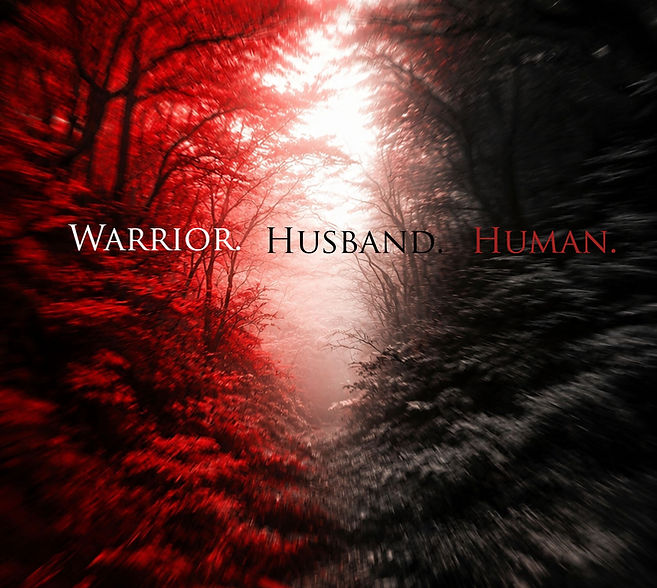
Those three words became a mantra throughout the series. It was Shindara's way of grounding himself in the present and remembering who he was when others wanted to erase him. It began as a simple code for survival, but over time, it became Shindara's moral compass. In a world torn by the Genpei War and haunted by yōkai, he needed to be a warrior to survive. Instead of fighting for glory or conquest, he fought to protect those he cherished.
As a husband, his love for Aya defined him more deeply than anything else. Loving her made him truly happy, so much so that his devotion bordered on heresy to his own faith. He wasn't supposed to cling to anything or anyone earthly because all things are taken away in time. To hell with death, not even that could diminish what he felt for her.
As a human, his greatest battle was with himself—to resist becoming a product of his own pain and hate. Instead, this story could be about holding onto his humanity and becoming a better person, even in the face of loss. I wanted Shindara to be the kind of man who took responsibility for his wrongs, who grew in empathy, and sacrificed himself for those he loved and those in need.
Perhaps that is the best way to live meaningfully when nothing else is certain. To choose grace over bitterness. Compassion over cruelty. The desire to help others even when you are hurting. While Shindara might have doubts about his own life and death, he would always trust in his mantra.
So would I.
_edited_edited.png)
-
Before the Genpei War broke out, the Taira clan sent unarmed soldiers to negotiate with the warriors monks in Nara. The monks attacked them instead, beheading over 60 negotiators. Lord Taira no Kiyomori then laid siege to the city with a much larger force.
-
During the siege of Nara, the Taira set fire to the main temples Kōfuku-ji and Tōdai-ji. They had become unwitting targets due to their political support for the Minamoto clan. A colossal bronze statue of the Vairocana Buddha inside Tōdai-ji's Great Buddha Hall melted partially in the attack, losing its head. This statue has been rebuilt and restored multiple times since then. The Great Buddha Hall has also been restored repeatedly since 1180 due to other fires and earthquakes.
-
During the Battle of Ishibashiyama, the Minamoto clan was overrun by the Taira by 3,000 samurai against 300. The tide of battle quickly turned against them as they made their last stand in the mountains of Hakone. Minamoto no Yoritomo hid in the husk of a dead tree until he was rescued by a soldier. These events were adapted into the finale of Obsidian Wraith.